
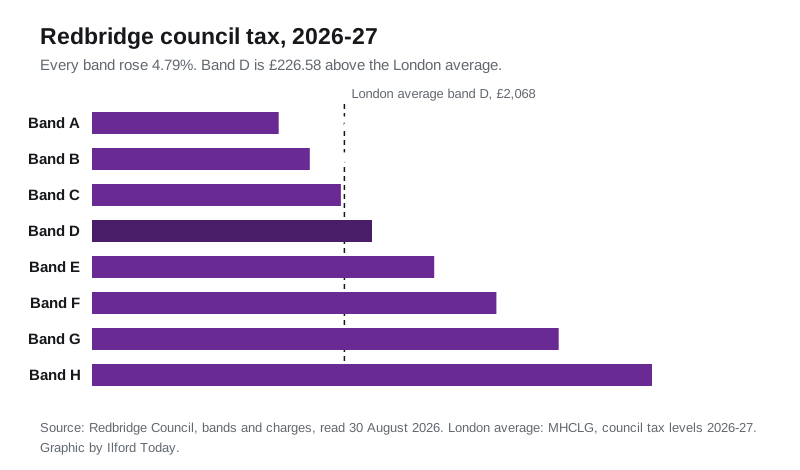
Every Redbridge band from £1,529.72 at A to £4,589.16 at H, all up 4.79%. Band D is £226 above the London average, and £510.51 of it goes to City Hall.
Band D council tax in Redbridge is £2,294.58 for 2026-27, up £104.91 on last year. That is £226 more than the average across London, and the increase, 4.79%, is faster than the London average of 4.4%.
Your bill has only two parts. The council’s own explanation of the bill says it shows how the money is split “between the London Borough of Redbridge and the Greater London Authority”, and nothing else. Everything below is from Redbridge Council, its 2026-27 council tax guide and MHCLG, checked on 30 August 2026.
Every band, this year and last
| Band | 1991 value | 2026-27 | 2025-26 | Increase |
|---|---|---|---|---|
| A | up to £40,000 | £1,529.72 | £1,459.78 | +£69.94 |
| B | £40,001 to £52,000 | £1,784.67 | £1,703.08 | +£81.59 |
| C | £52,001 to £68,000 | £2,039.63 | £1,946.37 | +£93.26 |
| D | £68,001 to £88,000 | £2,294.58 | £2,189.67 | +£104.91 |
| E | £88,001 to £120,000 | £2,804.49 | £2,676.26 | +£128.23 |
| F | £120,001 to £160,000 | £3,314.39 | £3,162.86 | +£151.53 |
| G | £160,001 to £320,000 | £3,824.30 | £3,649.45 | +£174.85 |
| H | over £320,000 | £4,589.16 | £4,379.34 | +£209.82 |
Every band went up by exactly 4.79%. The bands are fixed ratios of band D, set in law, so a band A home always pays two thirds of band D and a band H home always pays double.
The values in the second column are what the property was worth, or would have been worth, in April 1991. A flat built in Ilford last year is banded on an estimate of its 1991 value, not what it sold for.
Bills are spread over 10 instalments by default. You can ask the council to spread them over 12 instead, which cuts a band D monthly payment from £229.46 to £191.22.
Where the money goes
Band D splits like this, from the council’s own table:
| Redbridge | GLA | Total | |
|---|---|---|---|
| 2025-26 charge | £1,699.29 | £490.38 | £2,189.67 |
| General council tax, up 2.99% | +£50.80 | +£50.80 | |
| Adult social care precept, up 2.00% | +£33.98 | +£33.98 | |
| GLA element, up 4.1% | +£20.13 | +£20.13 | |
| 2026-27 charge | £1,784.07 | £510.51 | £2,294.58 |
Redbridge keeps 77.8% of the bill. The rest goes to City Hall for policing, the London Fire Brigade and transport.
The council presents its own rise as a single 4.99%, made up of the maximum 2.99% general increase plus the maximum 2% adult social care precept. Its guide describes the social care precept as 9p a day, and the GLA rise as 6p a day.
One small inconsistency to note. The council’s web page describes the GLA increase as “4.0%”, while its own printed guide says 4.1%. The arithmetic supports the guide: £20.13 on £490.38 is 4.10%.
How Redbridge compares
MHCLG’s figures for 2026-27 put the average band D at £2,068 across London, up 4.4%, and £2,392 across England, up 4.9%. London is the cheapest part of the country for council tax: of the 13 authorities in England with an average band D under £2,100, 11 are London boroughs.
Redbridge is not one of them. At £2,294.58 it sits £226.58 above the London average, and its 4.79% rise outpaced the London average too.
For scale, council tax is not where most of the council’s money comes from. Redbridge budgets gross spending of £1,095.0m in 2026-27 including the housing account, against a council tax requirement of £168.0m, up from £158.0m. Council tax funds about 15% of what the council spends. The two largest lines are Children’s Services at £482.3m, up from £454.1m, and Adult Social Care at £175.4m, up from £146.7m.
Checking and challenging your band
Redbridge does not set your band. The Valuation Office Agency does, and you can look up any property and start a challenge on GOV.UK. You must keep paying while a challenge is considered.
Expect a wait. The council warns that the VOA has moved to a new system and is running behind, and gives its current timescales as:
- up to 6 months to resolve a proposal or a request about banding
- up to 12 months to resolve a band review
New builds, splits and merges are affected by the same backlog.
Discounts and exemptions
- Single person discount, 25% off. Only one adult over 18 living there, and it must be your main home. Someone working away or on a long holiday does not count as moved out.
- Full-time students are exempt. A course of at least a year, 24 weeks of attendance and 21 hours of study a week. Halls of residence are exempt automatically. No discount if two or more non-students or part-time students live in the household.
- Apprentices qualify if they are working towards an accredited NVQ and earn no more than £195 a week.
- Disabled band reduction moves you down a whole band. You qualify if the disabled person uses a wheelchair indoors, or the home has a second bathroom or kitchen for their use, or a room is given over to dialysis, therapy or equipment storage. Stairlifts and handrails on their own do not count.
- Carer’s discount needs you to live with the person you care for, care at least 35 hours a week on average, and for them to get Attendance Allowance, the middle or higher rate DLA care component, or the standard or enhanced PIP daily living component. You do not need to be claiming Carer’s Allowance yourself. It does not apply to caring for a spouse, partner or your own child under 18.
- Severe mental impairment is a full exemption if you live alone, and a discount if you live with others. Each qualifying person applies separately.
- Also not counted as adults: under-18s, student nurses, under-25s funded by the Skills Funding Agency, British Council foreign language assistants, people who are severely mentally impaired, and diplomats.
The applications are all on the discounts and exemptions page.
Empty homes and second homes cost more, not less
There is no discount for an empty property in Redbridge, and after a year there is a penalty.
| Situation | Charge |
|---|---|
| Empty and unfurnished over 1 year | Double |
| Empty over 5 years, counted from 1 April 2020 | Triple |
| Empty over 10 years, counted from 1 April 2021 | Quadruple |
| Second home, since 1 April 2025 | Double |
The empty clock runs from when the property first became empty, even if it has since changed hands. Buying a long-empty house means inheriting the premium. It stops when you move in or furnish it.
Four things escape the second home premium: job-related properties such as a school caretaker’s house, which get 50% off instead; caravan pitches and boat moorings, also 50% off; homes left empty after a death, exempt for 12 months after probate; and properties actively marketed for sale or rent, where the premium can be deferred up to 12 months on proof of the marketing.
A property the VOA has deleted from the valuation list because it is derelict, uninhabitable or being rebuilt is not charged at all, but you have to apply to the VOA for that, not to the council.
Council Tax Reduction: 73% is the working-age ceiling
This is the part of Redbridge’s scheme worth reading carefully. A pensioner on a low income can have 100% of the bill covered. A working-age household never gets more than 73%, however low the income.
Redbridge runs five separate working-age schemes:
| Scheme | Maximum off | Who it is for |
|---|---|---|
| 1 | 73% | You or your partner get DLA, PIP, Attendance Allowance or Armed Forces Independence Payment |
| 2 | 60% | Dependent children, and on Income Support, JSA, ESA or Universal Credit while not working |
| 3 | 50% | As scheme 2, but no dependent children |
| 4 | 46% | Dependent children, working with joint earnings under £313 a week |
| 5 | 36% | No dependent children, working with joint earnings under £234 a week |
Other conditions that apply to all of them:
- savings must be under £16,000, unless you get Pension Credit Guarantee Credit
- nothing is awarded if the calculation comes out under £10 a week
- another adult in the house cuts the award by £10.59 a week if they are not working or are a full-time student, or £21.18 if they are working, with no deduction if they get Carer’s Allowance
- scheme 1 is the exception: no deduction for other adults at all
Pension-age deductions for other adults are £5.20, £10.60, £13.30 or £15.95 a week depending on that person’s income. A single pensioner sharing with a low-income adult who cannot contribute can claim Second Adult Rebate instead, worth up to 25% of the bill, but not if the second adult earns more than £375 a week.
If you applied for Universal Credit and ticked the Council Tax Reduction box, the DWP passes the claim on and you do not need to apply separately. Apply or check on the Council Tax Reduction page, and there is a separate hardship payment route if you are still short.
Also on Ilford Today
- Ilford bin collection days: what the bill buys, and what still costs extra
- Parking in Ilford: permit prices and every council car park tariff
- Ilford house prices: what homes in each band actually sell for
- Redbridge planning news: 337 homes built against a target of 1,409
Have your say